Why I Built DevGuild
The story behind DevGuild and what you can learn today.
Most coding courses teach you things you'll never use, and take way too long to get to the point.
I learned this the hard way. I spent several years as Director of Content for an educational platform, and two things became obvious: developers want to learn solutions to problems they're facing right now, and they want to get something functional in one sitting. Not next week. Not after 40 hours of video. Today.
Before that, I was a C++ developer, then a Solution Architect, and later a team manager. Good jobs, wrong fit. The moment I pivoted to developer education, everything clicked - and DevGuild is the result.
Why this matters more now
LLMs write code faster than you ever will. That's not the threat - it's the point. The engineers who thrive aren't the ones typing faster. They're the ones who know what to ask for.
Tell an LLM "build me a search feature," and you'll get something that works. Tell it "build me an inverted index with TF-IDF ranking and fuzzy matching on the query," and you'll get something good. The difference isn't prompting skill. It's knowing that inverted indexes, TF-IDF, and fuzzy matching exist - and when to reach for each one.
Software engineers are moving up an abstraction layer. The code writes itself. But patterns, algorithms, and architectural thinking don't. If you don't understand the fundamentals, you can't evaluate what your agent gives you, you can't debug it when it breaks, and you can't push it toward a better solution.
DevGuild teaches the things that make you dangerous with an LLM - not the things an LLM replaces.
How DevGuild works
You open a chapter. Instructions on the left. Editor on the right. You read the concept, you write the code, you hit check. The platform tells you if it's correct. No videos. No slides. No "follow along."
Here's the thing: reading about a for loop and writing a for loop are two completely different things. One gives you familiarity. The other gives you muscle memory. When you sit down to build something real - or to tell an LLM exactly what to build - you need the second kind.
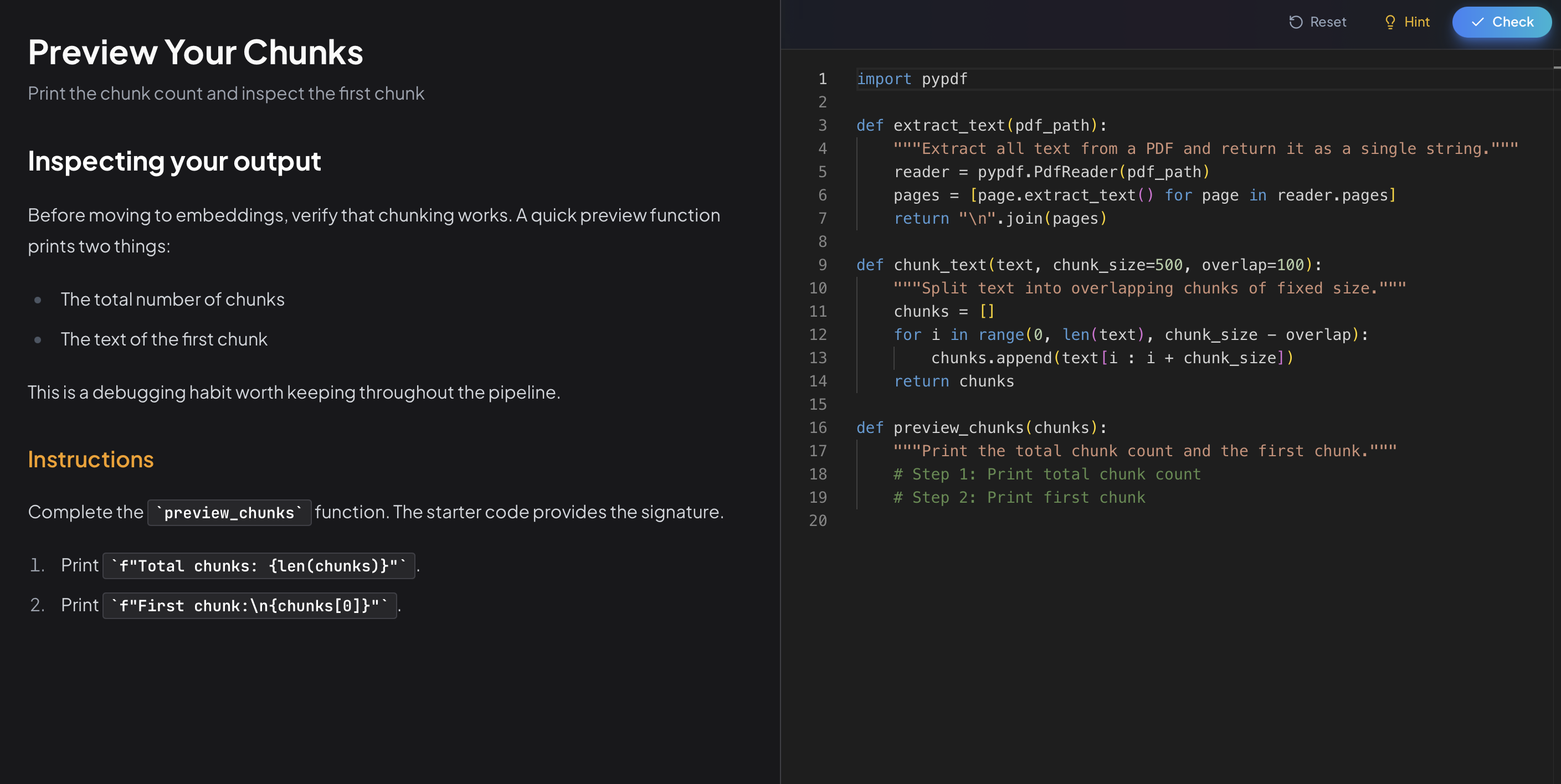
Every course builds toward a concrete project. You never learn a concept "for later." If you're learning about dictionaries, it's because you need one right now for the thing you're building. By the end, you have something that works - not a collection of notes about things that might work someday.
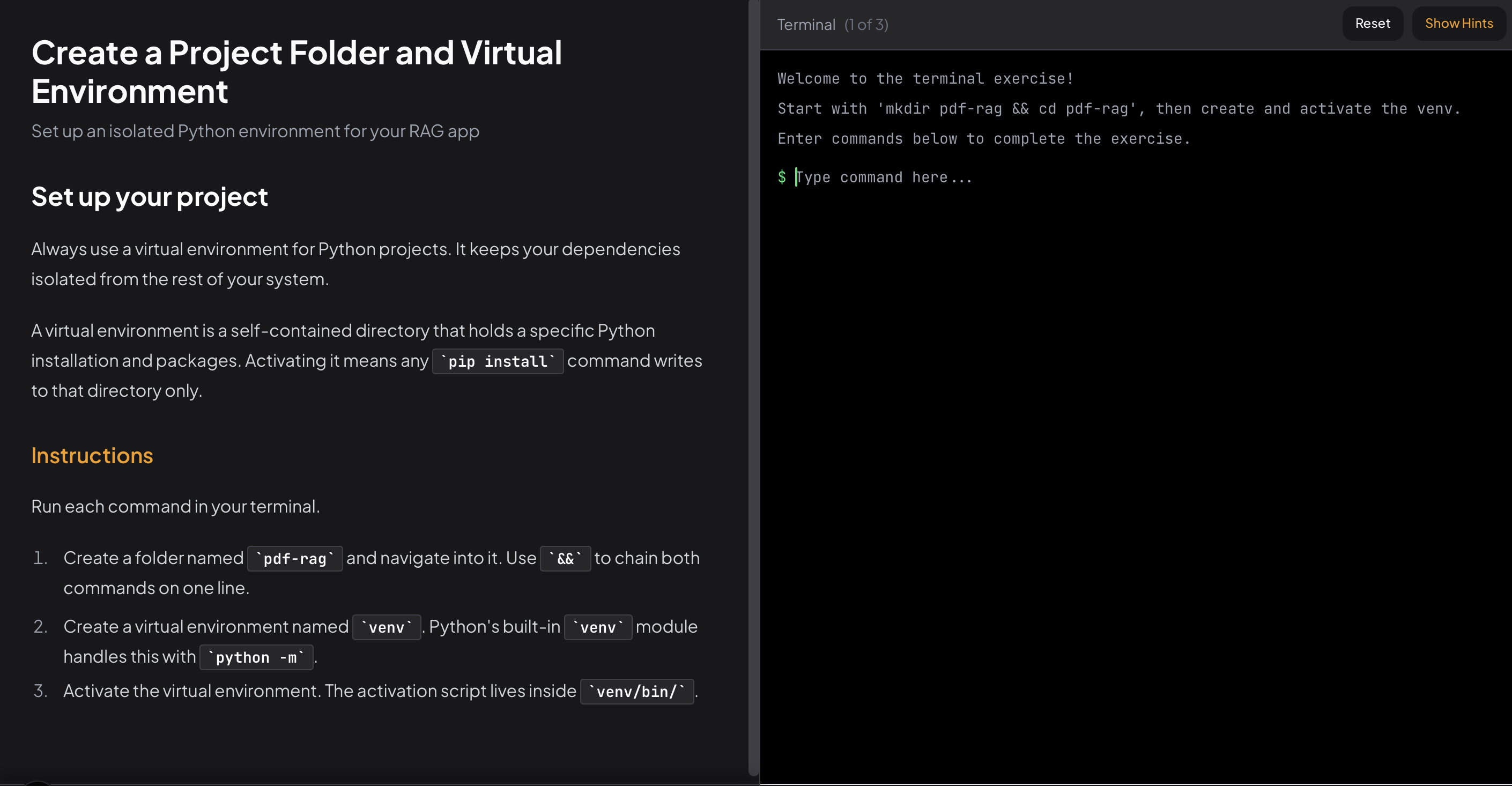
Writing code is half the job. The other half is knowing your way around a terminal - installing packages, running scripts, managing files. DevGuild teaches that too. Some chapters drop you into an interactive terminal where you run real commands, and the platform validates the output.
What you can learn today
Two learning paths are live right now, with more on the way.
-
Learn Python from Scratch: Three courses. You start from zero and end up building a Python quiz app that tests you on Python itself - a neat twist where the project and the subject are the same thing. Variables, control flow, functions, data structures - all introduced at the exact moment you need them to add the next feature. By the end, your app tracks streaks, awards score multipliers, logs mastery, and lets you add your own questions. No prior experience required.
-
Build AI Apps with Python: You build a RAG application that loads a PDF, splits it into chunks, generates embeddings with Google Gemini, and answers questions using vector search. This isn't a "what is AI" overview. You write real code that calls real APIs. By the end, you have a working app that can answer questions about any PDF you feed it.
What's coming next
Four more paths are in active development. Here's what I'm most excited about.
Computational Thinking - OOP, data structures built from scratch, algorithms, Big-O analysis, and a capstone where you build a text search engine with an inverted index and TF-IDF ranking. This is the path I talked about earlier - the skills that make you effective whether you're writing code or directing an LLM to write it for you.
Build APIs with Python - every course produces a working app. A REST API with FastAPI, a CLI task manager with Typer, a Telegram bot, a web scraper, and Docker deployment. Eight courses that take you from "I know Python" to "I ship things."
Python for AI - bridges the gap between basic Python and building AI tools. Working with files and data, modules and packages, and a capstone CLI data tool.
Build AI Apps with Python (expanding) - two more courses coming: an AI-powered terminal assistant and an AI agent that plans steps and executes tools. The think-act-observe loop, built from scratch.
Get in touch
I'm building this in public. If you have feedback, course requests, or want to follow along, find us on Twitter.

Founder of DevGuild. I build tools for developers and write about Python, AI, and web development.
@RealDevGuild